How to Start a Pet Health Journal
Quick answer: Every pet owner eventually gets asked the question that requires a historian: "So when did that start?" It sounds simple. Then you try to answer honestly and realize "recently-ish" is the most precise date your memory has. A pet health journal exists because animals change gradually — weight, appetite, energy, small habits — and the *date things changed* is usually the single most useful thing you can tell a vet.
Before you begin
The good news: a useful health journal is much less work than it sounds. Here's how to start one your household will still be keeping in six months, and how Petive keeps those dated entries in one place.
What a pet health journal actually is
A pet health journal is a dated record of observations about one animal, kept over time. Not a diagnosis, not an argument with symptoms — a timeline. When it works it answers questions like:
- when did the appetite change start?
- which weeks did the weight move?
- what did January's medication coincide with, exactly?
- what did we agree to watch after the last appointment?
The journal earns its keep at two moments: the day you're sitting in the vet's waiting room, and any ordinary Tuesday when you think "is this new, or has it been like this for a while?" — where "it" can be anything from drinking more water to a habit of staring at walls. If you want ground rules for what healthy looks like while you observe, the ASPCA's general pet care guides are worth having open in another tab.
The method: dated entries, no conclusions
Two habits keep a health journal alive instead of abandoned.
First: keep entries short and dated. One line is fine — what you did, gave, or noticed, and when. The log's value comes from dozens of small entries, not from beautiful prose.
Second: record observations, not conclusions. "Ate half her breakfast, seemed less interested in the evening walk" is journal material. "Has a stomach problem" is the vet's department — writing your own diagnosis into the record just guilts the chart into agreeing with you. The rule households find liberating is: *describe what you saw; leave interpretation to professionals.*
What to record
When people say "I don't know what to write" they usually mean no one gave them a list. A solid starter journal for a dog or cat covers:
- Eating and drinking — meals finished or refused, sudden thirst, treats
- Weight — on the interval your vet suggests, so trends become visible
- Energy and behavior — walks, play, sleep patterns, anything noted as "weird"
- Symptoms — with the date they appeared and roughly how long they lasted
- Medications and supplements — what started, when, and any effect noticed
- Appointments and advice — what was checked, what was prescribed, what you were told to watch
- Questions for the next visit — the classic way notes beat memory
That's it. Not every item every day — most entries are one or two of these.
Keeping a journal with Petive
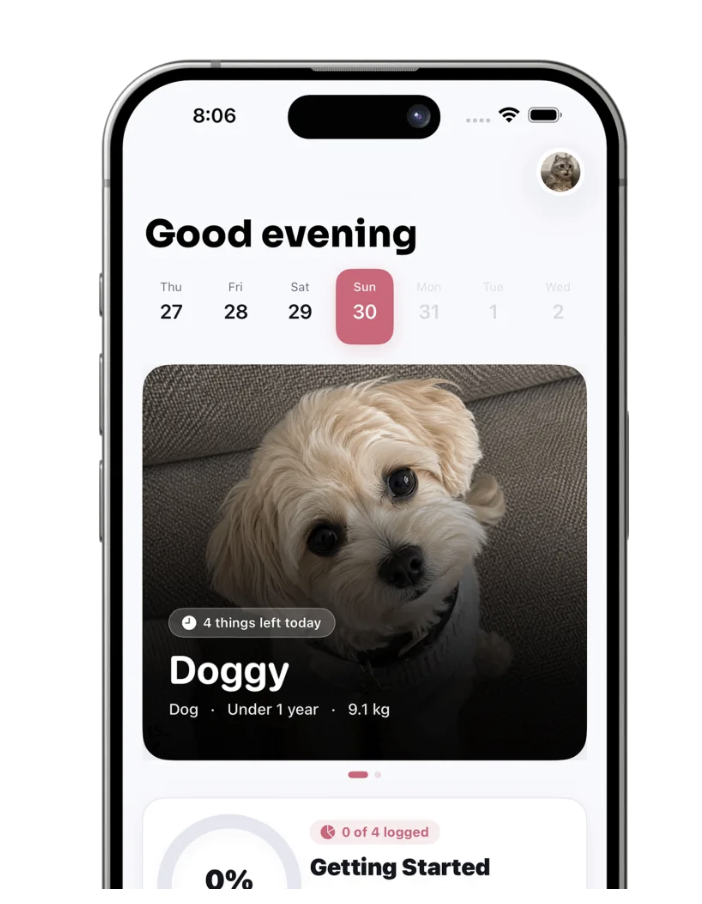
Petive is a pet care tracker for daily care, routines, reminders and health records on iPhone, and its health records are built exactly for this journal shape. Each pet keeps their own journal in one place.
Start a pet's profile, then simply add entries as they happen. During an ordinary day the quick log records meals, water and medication with a tap — the daily care log covers exactly what that surfaces — and each entry is dated and attributed to whoever did it, so the household's observations build one timeline instead of scattering across notebooks.
For the more "journalish" moments — symptoms you're watching, appetite changes, the question you want to ask next appointment — a dated note lands next to the day's care in the same timeline. When a visit comes up, you scroll a week or a month instead of reconstructing from memory, and everything sits together by pet.
The rule from earlier still holds: Petive organizes the record; it doesn't diagnose. What it does do is make sure that when you're asked "when did this start?" the answer is a scroll, not a shrug.
A weekly rhythm that works
If you like structure, a useful rhythm is: daily quick-log as care happens, and a Sunday minute where you skim the week and add anything that happened but wasn't logged — a skipped walk, an off appetite, a good win worth keeping. Households that share the care can divide this naturally, since each person's entries carry their own name.
Common questions
Is a pet health journal the same as my vet's records?
No. Your vet's medical record is the authoritative document and stays with your clinic. The journal is caregiver-entered observations that make vet conversations easier — it supports the record, it doesn't replace it.
How often should I write entries?
As often as something worth noting happens. Quick-log items (meals, water, walks, medication) take one tap; observations are for changes, questions, and vet-instructed watching. Journal inflation is a real risk — don't narrate normal days. If you want to see what a forgotten log costs, the double-feeding story is our cautionary classic.
Can our household keep the journal together?
Yes — entries in Petive record who added them, so a shared journal works without a battle over handwriting. Invited caregivers can see the pet's history and add their own entries.
Sources and editorial note
This guide was prepared by the Petive Editorial Team using guidance from established veterinary and animal-care organizations. Unless a named reviewer is shown, it has not been independently reviewed by a veterinarian. It provides general educational information, not veterinary diagnosis or treatment. Ask your veterinarian about your individual pet.